
What Is PROACT®? The Root Cause Analysis Method That Reaches Systemic Causes
PROACT® is a five-phase root cause analysis (RCA) methodology developed by Reliability Center, Inc. (RCI): PReserve, Order, Analyze, Communicate, and Track. It uses an evidence-verified logic tree to find the physical, human, and latent (systemic) causes of a failure, so the fix prevents a whole class of problems instead of just the last one.
Most failures that keep coming back were “fixed” at least once. Someone replaced the bearing, retrained the operator, or added a line to the procedure, and six months later the same work order showed up again. PROACT® exists because fixing what broke is not the same as fixing why it broke.
PROACT® at a glance
What does PROACT® stand for?
PROACT® stands for the five phases of a structured investigation. The first two letters come from PReserve, the step most investigations rush and later regret.

The process is a loop, not a line. What you learn in Track feeds the next investigation, and over time the whole RCA program gets sharper.
What makes PROACT® different from other RCA methods?
PROACT® is the only RCA methodology built to explicitly reach latent, or systemic, root causes. Most investigations stop at the first physical cause they can verify. PROACT® keeps going through three layers.
The tangible failure mechanism.
The bearing fatigued because it ran misaligned.
Fix it and you prevent:
That failure, on that machine
The decision, action, or inaction that triggered the physical root.
The mechanic installed the pump without a laser alignment.
Fix it and you prevent:
That error, by that person
The organizational conditions that allowed or encouraged that decision.
The site had no laser alignment tool, the procedure didn’t require one, and schedule pressure routinely beat the procedure.
Fix it and you prevent:
That class of error, across every person and machine the condition touches
This is where the return on an RCA lives. Replacing a bearing helps one pump. Fixing the alignment standard, the tooling, and the planning that let misalignment happen helps every rotating asset on site.
In PROACT®, human error is the starting point of the investigation, not the conclusion. Nobody comes to work planning to make a mistake. The question is always: why did that decision make sense to the person at the time? Answering it honestly is what keeps PROACT® blame-free and what gets people to tell you what really happened.
How does the PROACT® process work, step by step?
A PROACT® investigation moves through five phases. Each one has a specific job, and skipping one usually shows up later as a recurring failure.
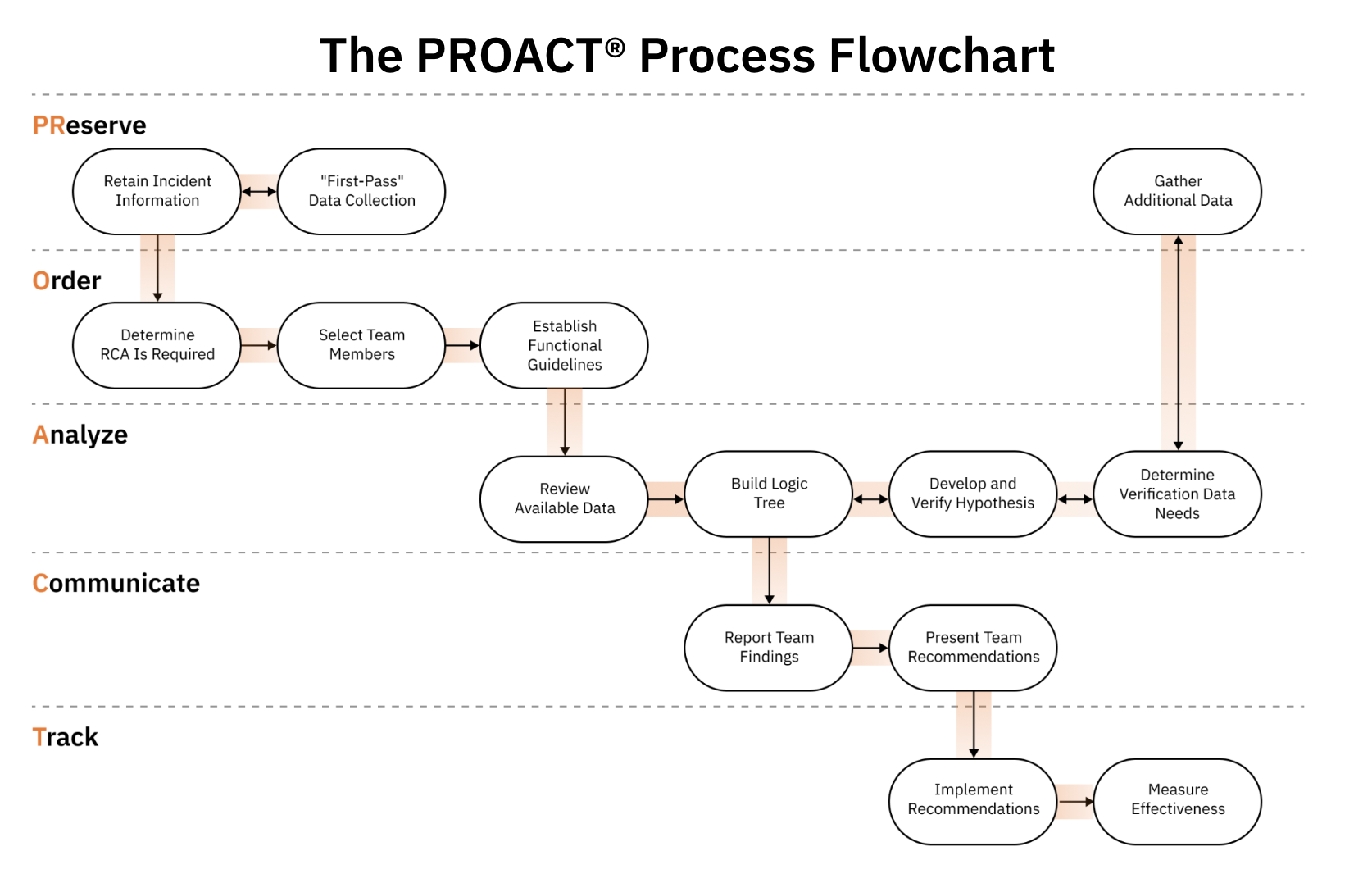
Select a phase to see the details.
1PReserve: how do you collect evidence for an RCA?
Preserve means capturing evidence before it degrades, using five categories called the 5 P’s: Parts, Paper, Position, People, and Paradigms. The quality of an RCA can never exceed the quality of the data preserved for it.
2Order: who should be on an RCA team?
Order means assembling a core team of three to five people with different perspectives, led by a principal analyst who is not the owner of the problem. The owner either already “knows” the answer or needs to protect themselves, and both bias the result.
Diversity matters more than seniority. In one RCI investigation, a team of metallurgists kept recommending more corrosion-resistant boiler tubes, and the tubes kept failing. A cross-functional team with a process engineer, an operator, and a mechanic found cool spots in the boiler dropping below the dew point of the combustion gases. It was a heat distribution problem, not a materials problem, and relocating the tubes ended it.
Every team works under a charter. Management commits time and resources and agrees not to punish honest mistakes. The team commits to a thorough, evidence-based investigation.
3Analyze: how does a PROACT® logic tree find root causes?
Analyze means building a logic tree that starts from verified facts and works down, layer by layer, asking “how could this have happened?” Every hypothesis is proven or disproven with data, never with opinion or seniority.
The tree starts with a top box that states the event and its modes in factual, observable terms. Getting this right matters. In one case, a VP was convinced a plant had a foaming problem and launched a 20-person team to investigate it. After weeks of work, they found no foam. The real issue was high-pressure safety trips caused by a filter media change from a supplier. Define the problem wrong and you can solve it perfectly and still lose.
From the top box, the team develops broad hypotheses, verifies each one, and keeps drilling down the paths that hold up. For component failures, four mechanisms cover almost everything: fatigue, corrosion, erosion, and overload. The analysis ends when the tree reaches the physical, human, and latent roots.
4Communicate: how do you get RCA recommendations approved?
Communicate means turning the findings into a report and recommendations that management will approve and fund. A root cause that never gets acted on is just an expensive opinion.
PROACT® ranks recommendations by how reliably they prevent recurrence:
- Forcing functions that make the error physically impossible
- Automation that removes the human decision
- Simplification and standardization
- Checklists and double-checks
- Rules and policies
- Education and training
Training is at the bottom for a reason. If someone knew the procedure and skipped it under time pressure, retraining them changes very little. Latent-root fixes tend to land at the top of this list, which is why they last.
When presenting, lead with the business case, show the logic tree as proof of rigor, and estimate benefits conservatively and costs liberally. Then ask for the approval to implement.
5Track: how do you know an RCA worked?
Track means confirming that each recommendation was implemented and that the failure actually stopped. Most RCA programs don’t fail in the analysis. They fail in the follow-through.
Track two things: completion (did we do what we said?) and effectiveness (did MTBF, downtime, or incident rates move?). Trend root causes across all your RCAs to spot systemic patterns. And go back to the people you interviewed to show them how their input changed things. That one step does more for future cooperation than any policy.
What is a PROACT® logic tree?
A PROACT® logic tree is a visual map of an investigation that connects a verified event to its physical, human, and latent root causes through a chain of tested hypotheses. It combines deductive and inductive reasoning, and every branch shows the evidence used to keep or eliminate it.

Key terms
Is all RCA the same?
When should you use PROACT® vs. 5 Whys or a fishbone?
No. Match the method to the risk. Use 5 Whys for low-impact, low-recurrence problems, a fishbone for moderate complexity, and a PROACT® logic tree when a failure is high-impact, likely to recur, or has more than one possible cause.
5 Whys
Quick troubleshooting, low impact
How deep it usually goes: One path, often stops at the first physical or human cause
How causes are confirmed: Knowledge of the people in the room
Fishbone (Ishikawa)
Moderate complexity, brainstorming categories
How deep it usually goes: Many possible causes, limited depth
How causes are confirmed: Depends on follow-up verification
PROACT® logic tree
High impact or recurring failures, multiple causes
How deep it usually goes: Physical, human, and latent roots
How causes are confirmed: Every hypothesis verified with data
The simpler tools have a place. The trouble starts when a single-path 5 Whys is used on a complex, recurring failure, and the investigation lands on “operator error” or “bearing failed” and stops. EasyRCA supports all three methods, so teams can scale the rigor to the event. If your team uses 5 Whys today, our free 5-Why Analysis training shows how to do it well.
Which failures deserve a PROACT® analysis?
Any failure with high impact or a high chance of happening again deserves a structured RCA, and that includes chronic failures most plants never investigate. The small failures that happen every shift often cost more per year than the big events that get all the attention.
| Sporadic failures | Chronic failures | |
|---|---|---|
| How often | Rare | Frequent |
| Cost per event | High | Low |
| Visibility | High | Low, absorbed into the budget |
| Gets an RCA? | Almost always | Almost never |
In RCI’s experience, chronic failures often cost four to six times more per year than sporadic ones. Consider a conveyor roller that stops a $1,260-per-hour line for 15 minutes, 2,080 times a year. That’s about $655,000 a year, and no single occurrence would trigger an investigation. RCI’s Chronic Failure Calculator helps you put a number on your own.
What results has PROACT® delivered?
PROACT® has been applied across steel, chemicals, food processing, cement, paper, energy, and more. The clearest published example of all five phases in the field comes from steelmaking.
Case study
ArcelorMittal: from nine catastrophic failures to about $1.15 million saved
At a steel mill then owned by Inland Steel (now ArcelorMittal), the lance carriage that lowers an oxygen lance into the Basic Oxygen Furnace failed catastrophically nine times, at roughly $250,000 per failure. MTBF was 2.5 months, and every failure got a repair but never an explanation.
The company trained 50 reliability engineers and more than 150 field employees with RCI, then ran a PROACT® analysis on the lance carriage:
Beneath the physical roots sat organizational ones: improper hug nut specifications, no torquing or alignment procedure, and no parts inventory for the new equipment.
After the changes, the furnace went 10 months without a lance drop, saving about $1.15 million compared with past performance.
The team then found the same alignment and torquing gaps in other areas and fixed those too.
Programs running PROACT® at scale

718 RCAs, $70M+ uncovered
718 RCAs across four business units and $70M+ in failure costs uncovered, after consolidating six different RCA tools into EasyRCA.
Read the ADM case study →
400 RCAs across 12 plants
400 RCAs across 12 plants in two years, a 25% reduction in unplanned kiln stops from 2024 to 2025, and about $96M in improvement impact identified. The rollout centered on training people in physical, human, and systemic roots.
Read the Ash Grove case study →
Beyond equipment failures
Adopted logic tree methodology and expanded RCA beyond equipment failures to safety and environmental events.
Read the International Paper case study →How do you learn PROACT®?
You can learn PROACT® through RCI’s on-site, live virtual, or on-demand training, from a four-hour introduction to a full certification. Teams that excel at RCA share a common language, and training is how they get it.
4 hours
PROACT® RCA Foundations
The five phases, the 5 P’s, physical, human, and systemic roots, and building a verified logic tree. Included free with every EasyRCA subscription.
Explore training →3 days
PROACT® RCA Certification
For the people who will lead investigations. Covers RCAs at every severity level, evidence collection, human and systemic contributions, team facilitation, and writing recommendations that hold. Available with hands-on mentoring on live-data exercises.
View course →1 day
Basic Failure Analysis
A one-day workshop on reading the physical evidence of failed components.
View course →Failure mechanisms
Why Parts Fail
A deeper workshop on fatigue, corrosion, erosion, overload, and the materials behind them.
View course →Human error
PROACT® Human Error Reduction Techniques
Why people make errors and how to design them out.
View course →Build in-house
RCA Train the Trainer
For organizations that want to build their own internal PROACT® instructors.
View course →Team training can be delivered at your site, with exercises built around your own equipment and failure history.
How does EasyRCA put PROACT® into practice?
EasyRCA is RCA software built by RCI, the same company that developed PROACT®, so the methodology is native to the platform rather than added on. It gives teams a digital logic tree, structured evidence collection, and corrective action tracking in one place.
Where did PROACT® come from?
PROACT® grew out of reliability work that RCI’s founder, Charles J. Latino, began in the early 1970s. He formally codified it when he founded Reliability Center, Inc. in 1985.
In 1973, Latino led what is credited as the first formal reliability program at Allied Chemical (later AlliedSignal, now part of Honeywell). His work centered on a simple idea: failures come from human decisions and the systems that shape them, so eliminating errors eliminates failures. That idea became PROACT®.
RCI has since trained tens of thousands of people and worked with teams in 55 countries. In 2020, RCI launched EasyRCA to bring PROACT® into modern, cloud-based software. Read more about Charles J. Latino
Ready to put PROACT® to work?
PROACT® gives your team one disciplined way to investigate failures, from the evidence at the scene to the systemic fix that keeps the problem from coming back. Start with training, or see how EasyRCA puts the methodology into daily practice.
Contact Us About Our RCA Programs
Frequently asked questions about PROACT®
What does PROACT® stand for?
PROACT® stands for PReserve, Order, Analyze, Communicate, and Track, the five phases of RCI’s root cause analysis methodology. The first two letters come from PReserve.
Is PROACT® the same as RCFA?
Not exactly. Root cause failure analysis (RCFA) usually refers to investigating equipment failures. PROACT® is an RCA methodology that handles equipment failures and also extends to safety, quality, environmental, and process events, and it always pushes past the physical cause to human and latent roots.
How long does a PROACT® RCA take?
It depends on the event. A focused analysis of a chronic equipment failure can often be done in a few working sessions. A major incident that needs lab work, multiple interviews, and data reconstruction can take several weeks. PROACT® scales the depth of the analysis to the size of the risk.
Can PROACT® be used for safety and quality incidents?
Yes. PROACT® applies to any undesirable outcome, including injuries, near misses, environmental releases, and quality defects. International Paper and ADM both use structured RCA beyond maintenance, in safety, environmental, and food safety investigations.
Do I need software to use PROACT®?
No. PROACT® is a methodology and has been practiced on paper for decades. Software like EasyRCA makes it easier to preserve evidence, verify hypotheses, track corrective actions, and trend root causes across many investigations and sites.
How do I get PROACT® certified?
Complete RCI’s three-day PROACT® RCA Certification course, offered on-site, live virtual, and on-demand. It’s designed for the people who will lead investigations in your organization.
What’s the difference between PROACT® and 5 Whys?
5 Whys follows a single chain of questions and works well for simple, low-impact problems. PROACT® builds a branching logic tree, verifies every hypothesis with data, and continues to the latent organizational causes, which makes it the better fit for high-impact or recurring failures.